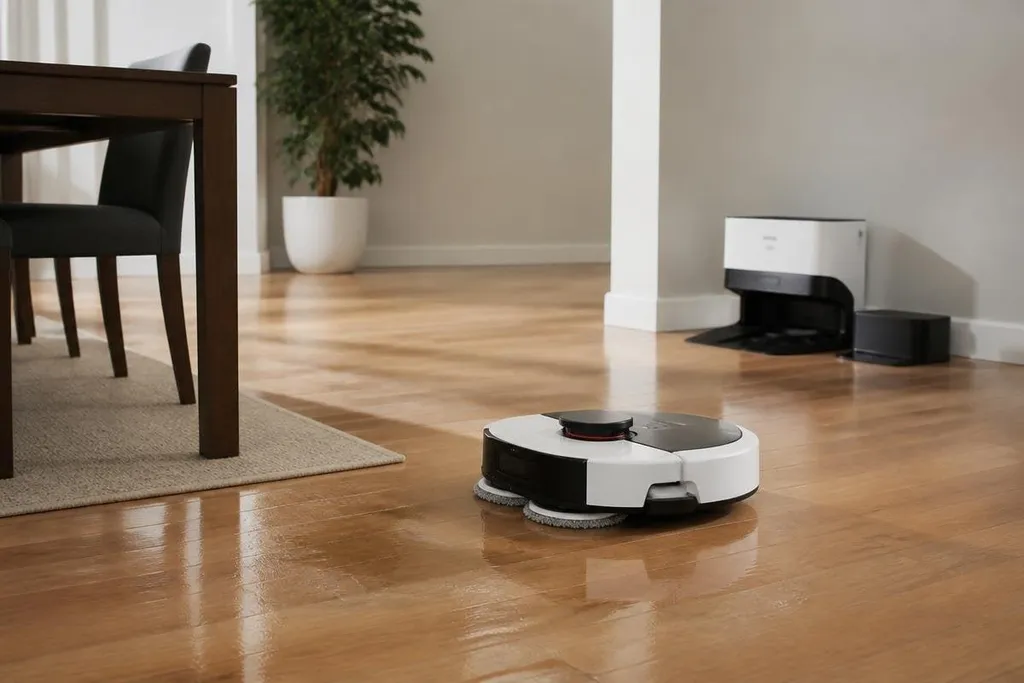
Useful cleaning robots will need to do more than move across a floor and avoid a chair. They’ll need to understand dirty areas, choose the right cleaning method, and finish the job without constant help.
- Better maps should help robots clean around changing furniture and narrow spaces.
- New sensors may help separate dust, spills, cables, and objects that need human care.
- The largest gap is still proof that these systems work well outside controlled demos.
Better maps for changing rooms
Many cleaning robots already build maps with cameras, LiDAR, or both. LiDAR measures distance with light pulses, while cameras help identify visual details such as furniture and floor edges.
A useful next step is a map that can change without losing track of the room. A chair moves. A door closes. A box sits in the usual cleaning path. The robot should update its route instead of treating the new object as a permanent wall.
That matters in homes, offices, and care sites where rooms change during the day. A robot that keeps an old map may leave parts of the floor untouched or spend too long trying to reach a blocked area.
The useful test will be simple: can the robot return to its dock, find the same room later, and keep its map after furniture moves? Product pages rarely answer that yet.
Floor sensing that changes the cleaning job
A robot that knows the floor type can choose a better cleaning action. Hard flooring, carpet, wet patches, and loose cables each create different risks for brushes, wheels, and suction systems.
That calls for more than obstacle detection. The robot needs to identify what sits under its wheels and near its cleaning head, then change speed, suction, brush movement, or water use.
A floor sensor can help prevent a wet mop from crossing carpet. Object recognition can help the robot avoid a charging cable instead of pulling it across the room. Neither feature matters much if the robot cannot make the correct change after detection.
A cleaning robot’s result depends on the handoff between sensing, software, and the cleaning tool. A camera can spot a spill, but the robot still needs to choose a route, lower the mop, and avoid wetting the carpet. Cleaning robot reports from Robot24.com can follow that process before the article turns to the arms and tools that do the work.
More useful arms and cleaning tools
Robotic cleaning has mostly focused on floors because a round body can move under furniture with little hardware. Further gains may come from tools that handle edges, shelves, sinks, and other surfaces.
A small arm could move a brush along a wall or pick up a light object blocking the floor. That sounds useful, but the arm adds weight, cost, safety questions, and more parts that can fail.
The tool also needs a clear job. A gripper that lifts a sock helps only if the robot knows where to place it. A brush that reaches a corner helps only if the robot can position it without scraping the wall.
For buyers, the question is not whether a robot has an arm. Check what the arm does without remote control, how much weight it can lift, and which surfaces the maker supports.
The dock becomes part of the system
A cleaning robot still depends on its dock for charging, emptying, water, and waste handling. A dock that handles more of this work can reduce daily attention, but it also adds filters, pumps, tanks, and cleaning parts.
That creates a new maintenance task. You may spend less time emptying a dust bin and more time washing a tank or replacing a filter. The maker needs to state how often each part needs care and what happens when a tank is full.
The open question is reliability over months, not a single cleaning run. A dock that works for a week tells you little about blocked tubes, dirty sensors, or worn brushes later.
A buying checklist for the next wave
Use this list when a product claims a major advance:
- Name the surface: Check whether the robot supports the flooring you have, including carpet edges and wet areas.
- Check the route: Look for evidence that it can update maps after furniture or doors change position.
- Test object handling: Ask what the robot does with cables, clothing, toys, and other small objects.
- Read the care schedule: Count filters, tanks, brushes, bags, and parts that need regular cleaning or replacement.
- Find the human fallback: Confirm how you recover the robot after a blocked route, failed dock, or lost map.
I’d wait for measured results from real homes or work sites before paying more for a robot that promises to handle every surface. The useful figure will be how many cleaning runs it completes without a person correcting its route.